
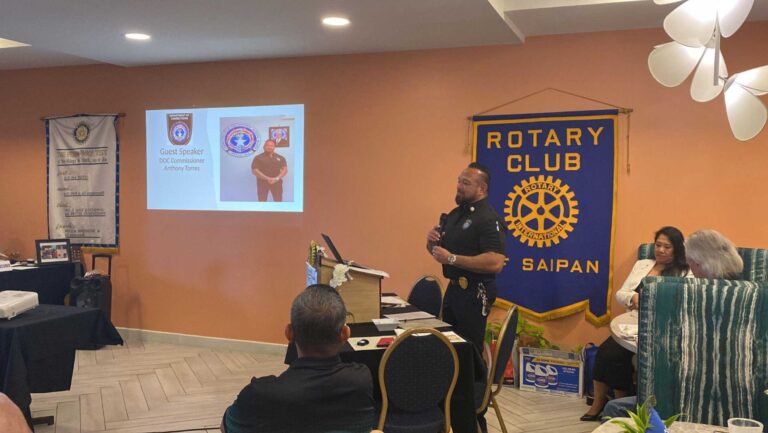
AS the guest speaker of the Rotary Club of Saipan on Tuesday, Department of Corrections Commissioner Anthony Torres was asked to talk about peace and conflict resolution.
Rotary International has designated February as Peacebuilding and Conflict Resolution Month.
In his remarks, Torres said emotional intelligence plays a key role in resolving conflicts.
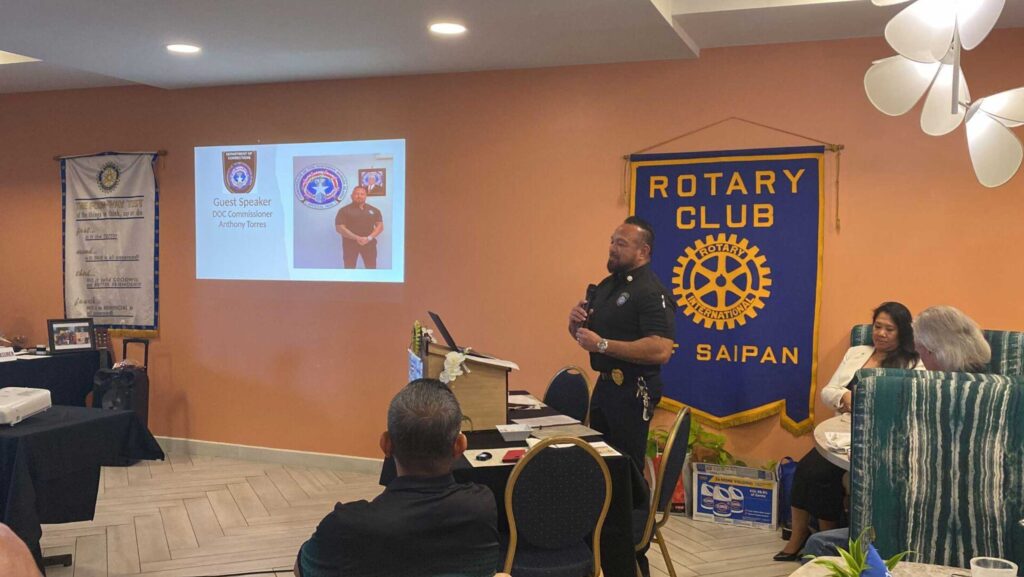
“My journey … as a correctional officer, clinician and now as commissioner of the Department of Corrections has greatly illuminated the transformative potential of emotional intelligence, the critical significance of effective leadership, and a relentless commitment to fostering peace,” Torres told the Rotarians.
He defines emotional intelligence as the ability to manage one’s emotions and to understand other people’s emotions.
Torres said emotional intelligence “improves human interactions and can lead to more effective communication and positive outcomes.”
He said he once facilitated group discussions for hardened offenders.
Through empathetic listening and emotional understanding, the inmates were encouraged to share their feelings in an environment of respect and safety. The inmates could then work through their “clash of perspectives” and “ever burning desire for redemption,” Torres added.
“It was there where I witnessed grown men become vulnerable in that group setting — [they] cried and wept in sorrow and disgrace,” he said. “These experiences have solidified my belief in the pivotal role of emotional intelligence in navigating through these intricate dynamics.”
He believes that emotional intelligence could help reduce recidivism.
“When [inmates] get out and they encounter a situation where temptation is there or the pressure is there from their peers to do something wrong … they can have that wherewithal to [say] ‘You know what? I’m not going to make the wrong choice that’s going to have me end up back in there,’ ” Torres said.
Emotional intelligence can “empower them to challenge their old thoughts,” he added.
The capacity to lead
Torres also elaborated on the concept of “warrior leadership.”
He said in addition to a capacity to lead, “warrior leadership” involves “courage, unity and resilience, even in the face of adversity,” and “a willingness to take calculated risks and lead by example,” among other qualities.
He said at the Department of Corrections, he aims to use “warrior leadership” and emotional intelligence in order to identify strengths and weaknesses in his team, and to provide “people with the opportunity to make a change.”
“I firmly believe that the bedrock of conflict resolution lies in recognizing and managing our own emotions, harnessing the force of empathy to understand the emotions of others and fostering an environment where effective and compassionate communication thrives,” Torres told Rotarians. “As we navigate the complexities of conflict prevention and resolution each of us holds a pivotal role. It is within our collective commitment to integrate emotional intelligence and warrior leadership [so] we can forge a culture of empathy and understanding and transform conflicts into opportunities for growth.”